
Our Picks

Kamado Joe Classic II (18")

PK Grills PK300-AF (Aaron Franklin Edition)
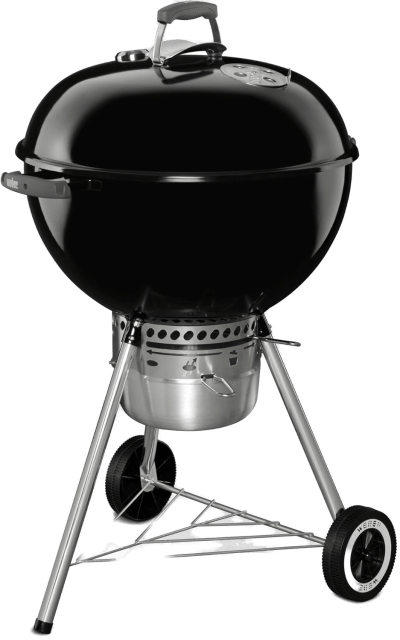
Weber Original Kettle Premium 22"

Weber Master-Touch 26"

Oklahoma Joe's Highland Offset Smoker
Introduction
Here's a fact that most grill reviews won't tell you: charcoal ash is hygroscopic. That means it actively absorbs moisture from the air. When that trapped water mixes with the minerals and salts in ash, it creates a mildly alkaline solution — chemically similar to diluted drain cleaner — that eats through steel from the inside out. Every time you finish a cook and leave the ash sitting in the bowl overnight, you're essentially marinating your grill in its own acid bath.
This is why "rust-proof" isn't just a marketing buzzword for outdoor cooking equipment. It's the single most important engineering decision a grill manufacturer makes. The material choice — ceramic, cast aluminum, porcelain-enameled steel, or bare steel — determines whether your grill lasts 3 seasons or 30 years. And yet, most buying guides skip the science entirely and jump straight to "it has 500 square inches of cooking surface."
We're not going to do that. This guide breaks down the actual material science behind why grills corrode, ranks the five best charcoal grills and smokers by longevity and rust resistance, and explains a $0 smoking technique that transforms a $229 kettle grill into a legitimate 8-hour smoker. Whether you're looking for a ceramic heirloom you'll pass to your kids or a proven workhorse that earns its keep through decades of replaceable parts, we've got you covered.
The Material Science of Grill Longevity (Why Grills Actually Die)
Before we talk about specific grills, you need to understand why steel grills rust in the first place — because the answer isn't as simple as "water + metal = rust."
Rusting Is an Electrochemical Reaction, Not Just Wetness
Steel is an alloy primarily made of iron. When iron is exposed to both oxygen and water simultaneously, a reaction called oxidation occurs. Iron atoms lose electrons to oxygen atoms, producing hydrated iron oxide — the flaky, reddish-brown substance we call rust. Unlike aluminum oxide (which forms a protective barrier), iron oxide is porous and expansive. It doesn't protect the metal underneath; it actively peels away, exposing fresh iron to the same reaction. It's a self-accelerating process.
Grills are ground zero for this reaction because they combine all three accelerators of oxidation: high heat (which speeds up chemical reactions), moisture (from rain, humidity, or food drippings), and electrolytes (salt from marinades, sea air, or the ash itself). Coastal environments are especially brutal — salt spray acts as an electrolyte that dramatically accelerates the electron transfer process.
The Four-Tier Material Hierarchy
Not all grill materials fail the same way. Here's the hierarchy, ranked from most to least durable:
Tier 1: Cast Aluminum — Aluminum cannot form iron oxide because it contains no iron. When exposed to air, it forms aluminum oxide, a microscopically thin, transparent, self-healing barrier that actively protects the metal underneath. A PK grill from 1962 looks weathered but structurally sound because this oxide layer has been protecting it for 60+ years. You can leave a cast aluminum grill uncovered in a saltwater hurricane, and it will not rust.
Tier 1 (tied): Ceramic — Ceramic is a non-metallic, non-reactive material that is chemically inert. It cannot rust, corrode, or degrade from moisture exposure. Kamado-style grills are built from thick-walled ceramic that serves double duty: it provides structural integrity and exceptional thermal insulation. The trade-off is fragility — ceramic can crack from physical impact or extreme thermal shock (e.g., pouring cold water into a 700°F firebox).
Tier 2: Porcelain-Enameled Steel — Porcelain enamel is essentially glass fused to steel at extremely high temperatures. As long as the coating is intact, it provides an excellent barrier against moisture and oxygen. This is why Weber grills routinely last 10-15 years with basic care. The failure mode is chipping: if the porcelain is cracked by impact (dropping the lid, banging it with tongs), the exposed steel underneath rusts aggressively because moisture gets trapped between the coating and the metal.
Tier 3: Bare/Painted Steel — The paint on an offset smoker's firebox is cosmetic, not structural. Factory paint is not rated for the 500-700°F temperatures a firebox regularly reaches. It will bubble, crack, and peel — often within the first few uses. Once the paint fails, bare steel is fully exposed to the oxidation cycle. This is why offset smokers like the Oklahoma Joe's Highland demand active maintenance rituals: oiling, touch-up painting, and religious ash removal.
The Stainless Steel Myth: "Stainless" steel is not stain-proof. It contains at least 10.5% chromium, which forms a protective chromium oxide layer. However, this layer can be damaged by high heat, chloride exposure (from salt), or even certain cleaning chemicals. Grade matters enormously: 304 stainless (the standard for quality grill grates) holds up well; cheaper 430 stainless can and does rust under charcoal heat.
Kamado Joe Classic II — The Ceramic Heirloom

Kamado Joe Classic II (18")
Pros
- Ceramic body is physically incapable of rusting — not rust-resistant, rust-proof
- Thick-walled ceramic provides unmatched heat retention, using 50-75% less charcoal than steel grills
- Divide & Conquer cooking system enables multi-zone, multi-level cooking from 225°F to 750°F
- Lifetime warranty on ceramic parts; Air Lift Hinge reduces dome weight for one-handed opening
Cons
- Weighs 233 lbs — once placed, it's essentially permanent furniture
- Ceramic can crack if dropped or subjected to sudden thermal shock (rare, but possible)
- Metal components (grates, hinge, gaskets) will still need periodic replacement over decades
- At ~$1,399, the upfront investment is 6x that of a Weber kettle
Specifications
Why Ceramic Is the Ultimate Rust-Proof Material
Ceramic doesn't resist rust — it's physically incapable of it. There is no iron to oxidize, no metal to corrode, no coating to chip. The thick-walled ceramic shell of the Kamado Joe Classic II is, from a corrosion standpoint, effectively immortal. Kamado-style grills that were manufactured in Japan in the 1960s are still functioning today because the material simply does not degrade from environmental exposure.
But the Classic II's longevity story goes beyond just the body. The Kontrol Tower top vent is cast from aluminum — another material that cannot rust. The AMP (Advanced Multi-Panel) FireBox is designed with segmented panels that flex independently, dramatically reducing the risk of cracking from thermal expansion. And the wire-mesh fiberglass gasket replaces the felt gaskets found on cheaper kamados, which degrade and need replacement every few years.
The Hidden Efficiency Advantage
Here's something most reviewers mention but don't quantify: ceramic's thermal mass means you use 50-75% less charcoal than a steel grill for equivalent cooks. A kamado can maintain 225°F for a 12-hour brisket cook using roughly 8-10 lbs of lump charcoal. A steel kettle doing the same cook burns through 15-20+ lbs. Over years of cooking, the charcoal savings partially offset the higher purchase price.
The Divide & Conquer flexible cooking system uses half-moon grates that sit at multiple heights, letting you sear steaks on one side at 600°F while smoking vegetables on the other at 300°F. It's the most versatile cooking system in this roundup, capable of grilling, smoking, baking, roasting, and even pizza at temperatures up to 750°F.
What Can Actually Break
Ceramic is the body's greatest strength and its only vulnerability. Kamados can crack from physical impact (dropping, tipping over) or extreme thermal shock (though this requires genuinely reckless behavior, like submerging a 700°F firebox in cold water). In normal use, the ceramic is bulletproof. The metal components — grates, hinge hardware, gaskets — are the consumable parts you'll replace every 5-10 years. Kamado Joe's warranty reflects this: lifetime on ceramic, 5 years on metal parts, 3 years on heat deflectors.
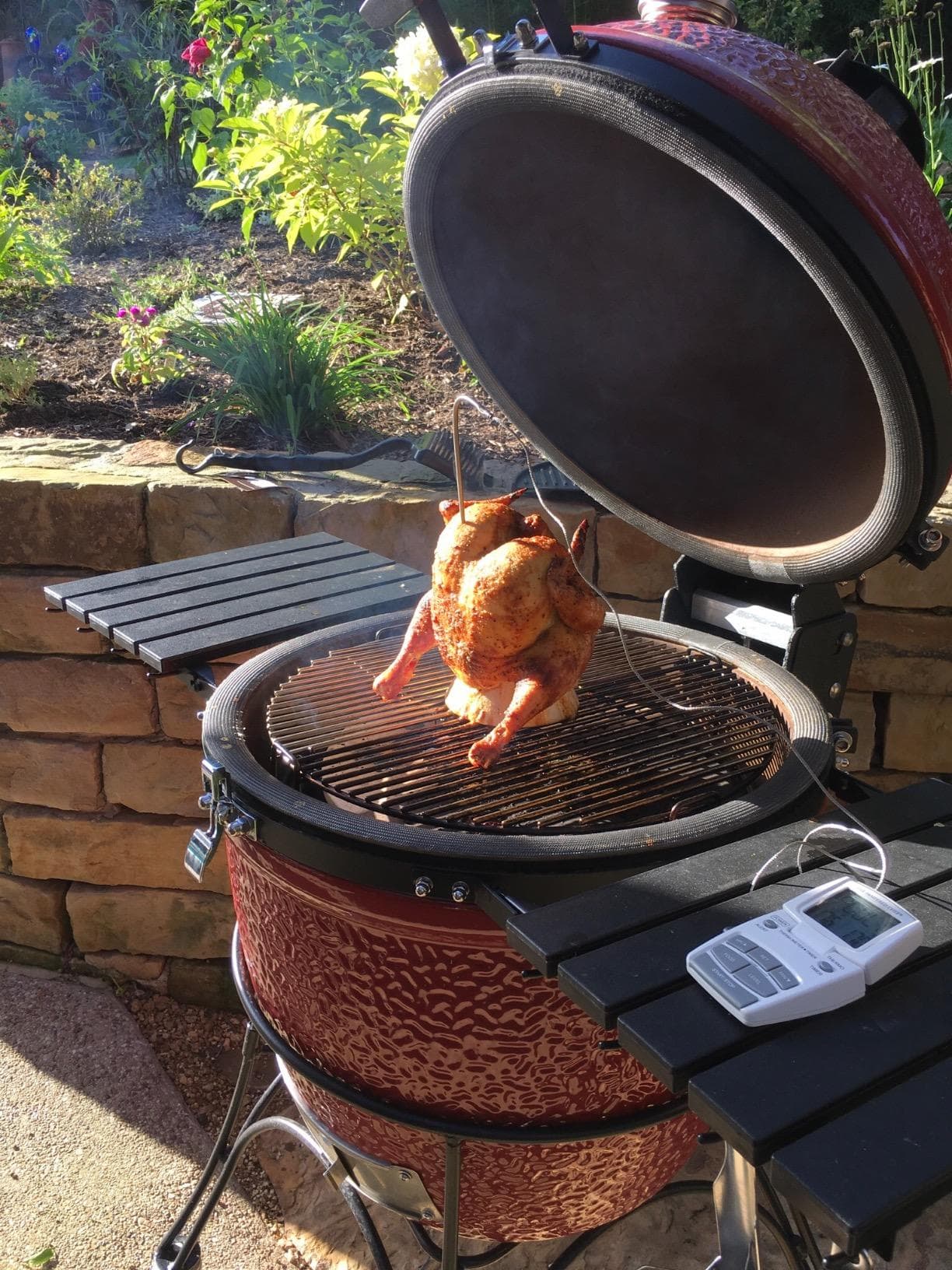
Kamado Joe Classic II interior and firebox detail
PK Grills PK300-AF (Aaron Franklin Edition) — The Indestructible Heirloom

PK Grills PK300-AF (Aaron Franklin Edition)
Pros
- Cast aluminum body is 100% rust-proof by material science — aluminum oxide is self-healing
- Co-designed by Aaron Franklin (James Beard Award winner) with speed racks, belly bar, and dual shelves
- 4-point radial venting system provides competition-level temperature control for smoking and searing
- At ~60 lbs, it's light enough to be genuinely portable, unlike 200+ lb ceramic kamados
Cons
- Cast aluminum conducts heat well but lacks the sheer thermal mass of ceramic for ultra-long cooks
- 300 sq in cooking surface is tight for feeding crowds larger than 6 people
- At $799+, it costs significantly more than a Weber kettle for a simpler feature set
- Stainless steel grates will eventually need replacement, even if the body never will
Specifications
The Science of Self-Healing Aluminum
Here's a material science fact that makes cast aluminum grills fascinating: when you scratch the surface of a PK grill, you're not creating a vulnerability — you're triggering a self-repair mechanism. Aluminum instantly reacts with atmospheric oxygen to form aluminum oxide (Al₂O₃), a microscopically thin, incredibly hard, transparent layer that seals the scratch and prevents further corrosion. This happens within milliseconds. Unlike iron oxide (rust), which is porous and expansive, aluminum oxide is dense and protective. The more you "weather" a PK grill, the more protected it becomes.
This is why PK grills from the 1960s are still in active daily use. The original Portable Kitchen grill was designed in Little Rock, Arkansas in 1952, and there are documented examples of units that have been passed through three generations of families. r/BuyItForLife consistently rates PK Grills as the number one recommended charcoal grill, and the community sentiment is unanimous: these are heirloom-quality tools.
Why the Aaron Franklin Edition Is the One to Buy
Aaron Franklin — the pitmaster behind Franklin Barbecue in Austin, Texas, the only barbecue restaurant to receive a James Beard Award — didn't just lend his name to PK Grills. He spec'd out custom modifications to the PK300 that solve real pitmaster workflow problems. The PK300-AF includes integrated speed racks that hold two standard sheet pans for prepping and transporting ingredients, a belly bar for hanging towels and tools within arm's reach, and dual collapsible cast aluminum shelves for workspace. These aren't cosmetic upgrades — they're the kinds of things a professional who cooks thousands of briskets a year actually needs.
The core PK300 platform underneath is pure cast aluminum with a 300 sq in cooking surface, the signature 4-point radial venting system for precise two-zone temperature control, a Tel-Tru thermometer, and the iconic capsule-shaped body that creates natural convection zones for intuitive direct/indirect heat management. Available in exclusive Franklin Teal and Coal Black colorways.
Where It Trades Off
Cast aluminum conducts heat exceptionally well, but it lacks the sheer thermal mass of a 233-lb ceramic kamado. For ultra-long cooks (14+ hours), you'll likely need to add charcoal once or twice, whereas a kamado might run the entire cook on a single load. The 300 sq in cooking surface is adequate for most families (4-6 people) but tight for large gatherings. At $799+, it's expensive for a grill without smart features — but the price reflects the fact that you'll never need to buy another grill body again.

PK Grills PK300-AF Aaron Franklin edition grill capsule showing side shelves
Weber Original Kettle Premium 22" — The Backyard Gold Standard

Weber Original Kettle Premium 22"
Pros
- Porcelain-enameled bowl and lid resist rust, peeling, and high-heat degradation for years
- Every single component is replaceable — grates, ash sweeps, legs, handles — enabling decades of service
- The snake method transforms this $229 grill into a genuine 6-8 hour smoker maintaining 225°F–275°F
- Rust-resistant aluminum damper and One-Touch cleaning system with enclosed ash catcher
Cons
- Porcelain enamel can chip from impacts, exposing the steel underneath to localized rust
- Plated steel cooking grate is serviceable but not as durable as stainless or cast iron
- The 22" size (363 sq in) gets tight for whole briskets or cooking for 10+ people
- No built-in smoke damper setting — temperature control for smoking requires manual vent adjustment
Specifications
Why the Weber Kettle Has 70 Years of Proof Behind It
George Stephen Sr. invented the Weber kettle in 1952 by cutting a metal buoy in half and adding legs and vents. Over seven decades later, the fundamental design is essentially unchanged — because it didn't need to change. The porcelain-enameled steel bowl and lid resist rust, peeling, and heat degradation with a track record that no other grill category can match: 12,700+ Amazon reviews at 4.8 stars, and a 10-year warranty that Weber honors without argument.
But here's the Weber secret that separates it from disposable grills: every single component is individually replaceable. Grate worn out after 7 years? $25. Ash sweep mechanism corroded? $12. Legs dented? $30 for a set. Weber sells replacement parts for models going back decades. This transforms the Weber kettle from a consumable appliance into a Ship of Theseus — you can replace every part, one at a time, and the grill keeps going indefinitely. The body itself, protected by that porcelain enamel, is the last thing that ever needs replacing.
The Snake Method: How a $229 Grill Becomes an 8-Hour Smoker
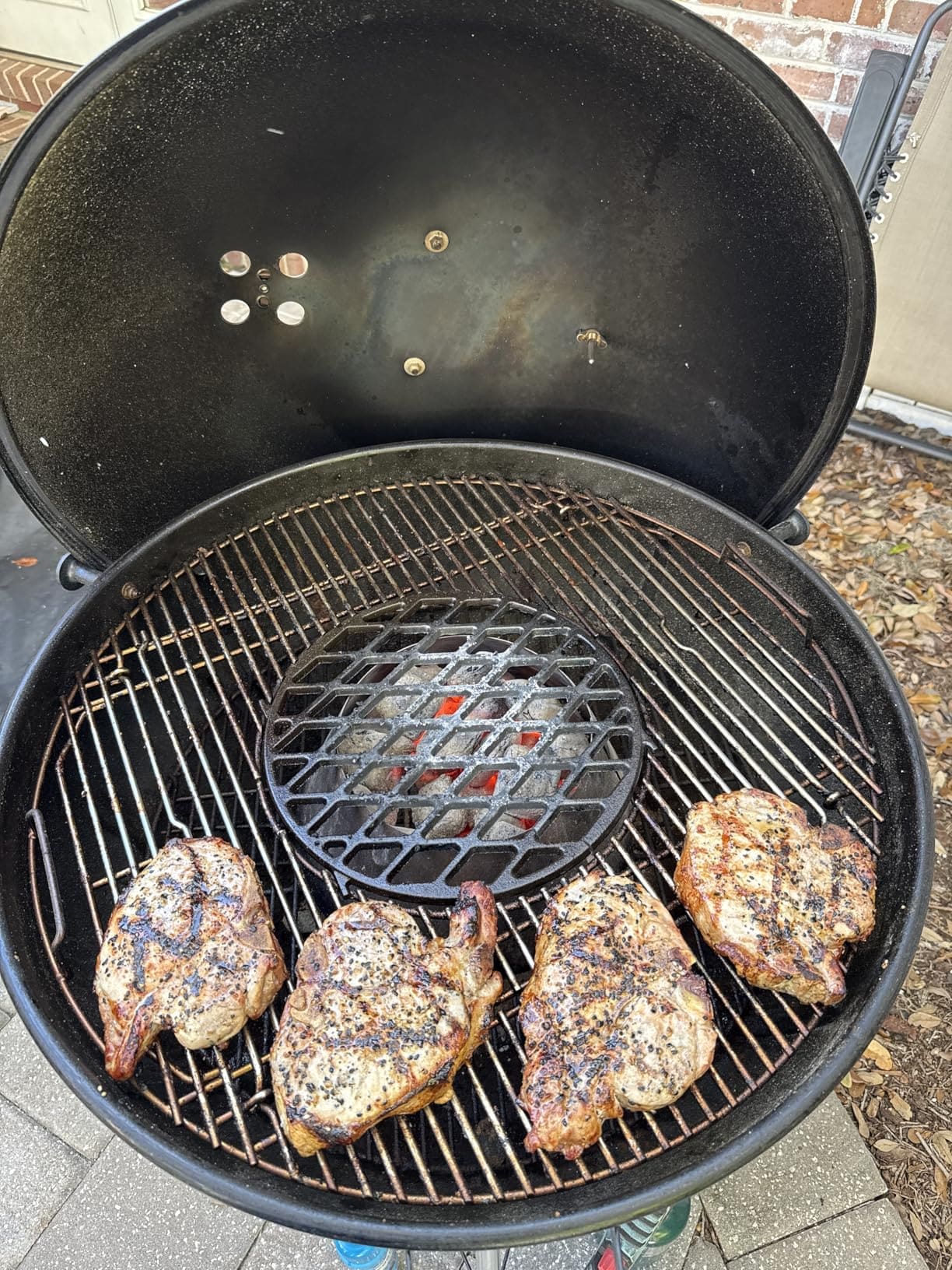
This is the technique that most buying guides either skip or mention in passing, and it fundamentally changes the value proposition of a Weber kettle. The snake method (also called the fuse method or C-method) transforms any kettle grill into a legitimate low-and-slow smoker without any modifications or accessories:
Setup: Arrange unlit charcoal briquettes in a C-shaped row along the inside edge of the charcoal grate — two briquettes wide, two briquettes tall, leaned against each other at a 45° angle. Place hardwood chunks (hickory, oak, cherry) on top of the briquettes every few inches. Set a foil water pan in the center of the grate.
Ignition: Light 8-10 briquettes in a chimney starter until fully ashed over. Place them at one end of the snake. The fire slowly crawls along the unlit briquettes, burning for 6-8 hours without intervention.
Temperature Control: Use Kingsford Original briquettes (uniform size, predictable burn). Keep the top vent fully open. Adjust the bottom vent to dial in 225°F-275°F. The water pan acts as a thermal buffer, absorbing excess heat and adding humidity. Make small adjustments and wait 10-15 minutes before changing again.
This method consistently produces competition-quality pulled pork, ribs, and brisket on a $229 grill. It's the reason the Weber kettle community is so passionate — they know something most gas grill owners don't.

Weber Original Kettle Premium 22-inch on patio
Weber Master-Touch 26" — The Serious Smoker's Kettle
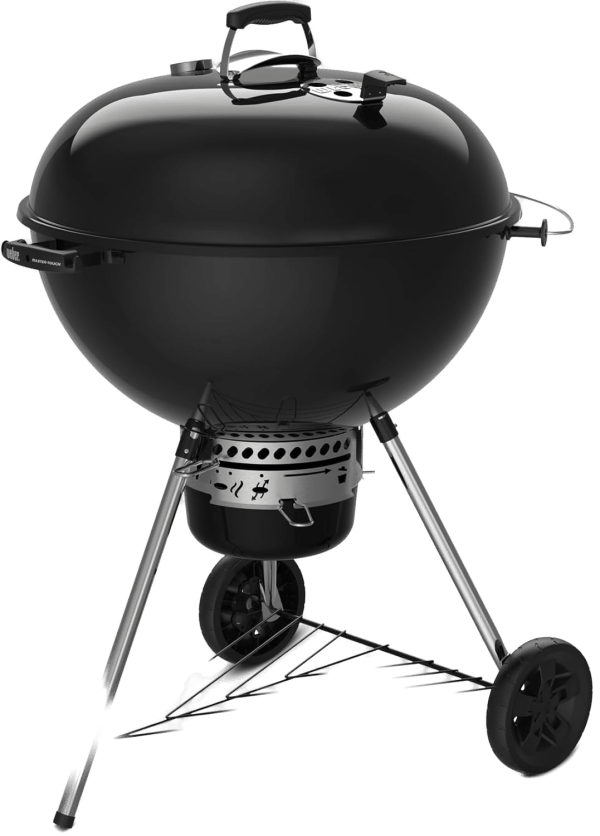
Weber Master-Touch 26"
Pros
- 508 sq in cooking surface (40% more than the 22") fits whole briskets and feeds 10+ guests
- Dedicated smoke damper setting on bottom vent makes low-and-slow smoking a built-in feature
- WEBER CRAFTED stainless steel hinged grate accepts interchangeable grillware (pizza stone, griddle)
- Same porcelain-enamel durability as the 22" with a 10-year warranty and full parts availability
Cons
- At $578, it's more than double the 22" — a significant premium for the size upgrade
- Larger diameter requires 30-40% more charcoal per cook than the 22" kettle
- Aftermarket accessories for the 26" are fewer and pricier than the deeply supported 22" ecosystem
- Heavier and bulkier — not as easy to store or move as the compact 22"
Specifications
The Smoke Damper Changes Everything
If the 22" kettle is the gateway drug, the 26" Master-Touch is the prescription-strength version. The headline upgrade isn't the size (though 508 sq in vs. 363 sq in is a 40% increase) — it's the dedicated smoke damper setting on the bottom vent. This is a preset notch that locks the damper at the optimal airflow opening for maintaining low-and-slow temperatures. On the 22" kettle, achieving stable 225°F requires manual vent fiddling, constant monitoring, and experience-earned intuition. The 26" Master-Touch's smoke damper setting takes the guesswork out of the equation.
The WEBER CRAFTED stainless steel hinged grate is the other major upgrade over the 22". Where the standard kettle uses plated steel (which will eventually show rust at the weld points after years of use), the Master-Touch uses stainless steel that resists corrosion significantly longer. The WEBER CRAFTED system also accepts interchangeable grillware inserts — a pizza stone, a searing grate, a plancha griddle — that snap into the hinged grate frame. It's a modular cooking system built on a kettle platform.
Who This Is For vs. The 22"
The 22" kettle is the sweet spot for households of 2-6 people who grill 2-3 times a week. It's lighter, cheaper, and has a vastly larger ecosystem of aftermarket accessories. The 26" Master-Touch is for people who regularly cook for 8+ people, who want to smoke whole briskets (which physically don't fit on a 22" grate), and who want built-in smoking hardware rather than mastering manual vent control.
The trade-off is economics: the 26" costs $578 (more than double the 22"), requires 30-40% more charcoal per cook, and has fewer and more expensive aftermarket accessories. If you're primarily grilling burgers and steaks for a family of four, the 22" is the better buy. If you're doing monthly brisket cooks for neighborhood cookouts, the 26" Master-Touch earns its premium.
Weber Master-Touch 26-inch highlighting smoke damper setting
Oklahoma Joe's Highland — The Pitmaster's Workhorse

Oklahoma Joe's Highland Offset Smoker
Pros
- 900 sq in total cooking area (619 primary + 281 firebox) handles competition-volume cooks
- Porcelain-coated wire cooking grates resist rust in the area that matters most — food contact
- True offset firebox design produces authentic wood-fire flavor that kettle grills cannot replicate
- Firebox doubles as a secondary grill for direct high-heat cooking
Cons
- Factory paint on the firebox WILL fail — it's designed for cosmetics, not high-heat protection
- Heavy-gauge steel body requires active rust prevention: covers, oiling, touch-up paint
- Fire management is a learned skill — this is not a set-it-and-forget-it cooker
- At 178 lbs and over 4 feet wide, it demands dedicated patio real estate
Specifications
The Case for an Offset Smoker (Even in a Rust-Proof Guide)
We included the Oklahoma Joe's Highland on a longevity-focused list for the same reason a car guide includes a manual transmission sports car alongside reliable sedans: because nothing else does what it does. A true offset smoker — where the fire burns in a separate firebox and the smoke flows through the cooking chamber — produces a flavor profile that kettle grills and kamados cannot fully replicate. The combination of radiant heat, convective smoke flow, and rendered drippings hitting the fire creates a depth of bark and smoke ring that BBQ competition judges actively look for.
The Highland gives you 900 sq in of total cooking area (619 primary + 281 in the firebox), which handles four pork shoulders simultaneously, a full competition load of ribs, or a whole brisket with room for sides. The firebox doubles as a secondary grill for direct high-heat searing — a legitimately useful feature that many offset owners discover accidentally and then can't live without.
The Honest Durability Picture
Let's be direct: the Oklahoma Joe's Highland is not rust-proof. The factory paint — particularly on the firebox — is cosmetic-grade and will bubble, crack, and peel under the sustained 500-700°F temperatures the firebox regularly reaches. This is not a defect; it's a known characteristic of mass-produced offset smokers in this price range. Custom-welded pits with high-temperature ceramic coatings start at $2,000+.
However, with a disciplined maintenance routine, Highland owners consistently report 10+ years of reliable service:
The Maintenance Ritual:
- After every cook: Remove all ash once cooled (remember — wet ash creates lye). Wipe the firebox interior with a thin coat of vegetable oil.
- Monthly: Inspect for paint failure. Wire-brush any flaking paint and touch up with Rust-Oleum high-temperature spray paint ($8 a can).
- Always: Use a fitted, weather-resistant grill cover. This single step prevents 80% of the rust that kills offset smokers.
The porcelain-coated wire grates protect the food-contact surface from rust, and the heavy-gauge steel construction provides the thermal mass needed for stable, long-duration cooks. If you treat the Highland like a tool (maintain it) rather than an appliance (ignore it), it will reward you with a decade or more of authentic offset smoking at a fraction of the cost of a custom pit.
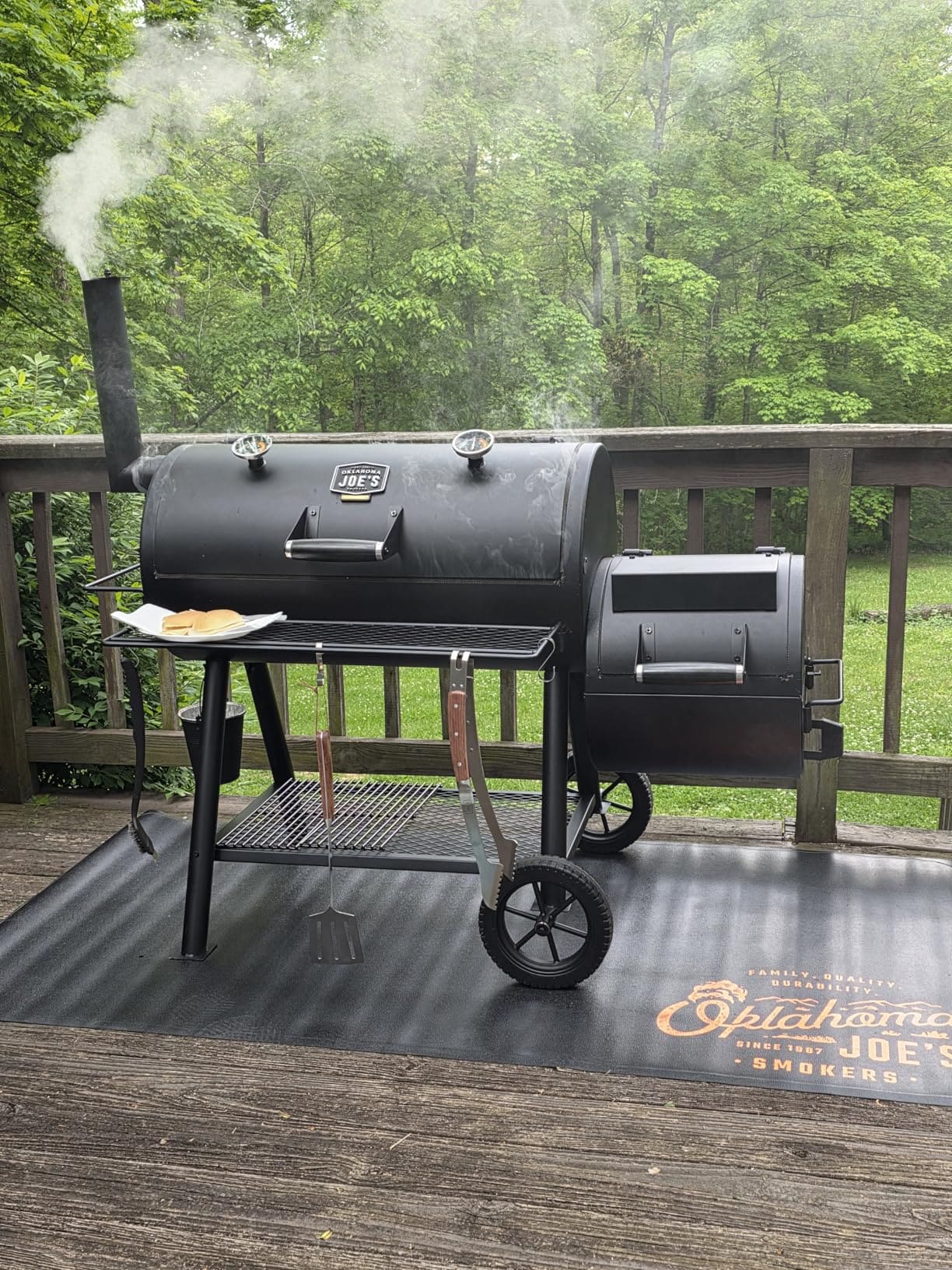
Oklahoma Joe's Highland offset smoker showing firebox and cooking chamber detail
The Longevity Playbook: How to Make Any Grill Last Decades
Regardless of what material your grill is made from, these five habits will dramatically extend its lifespan:
1. Clean Out Ash Within 24 Hours of Every Cook
This is the single most impactful maintenance habit you can adopt. Ash is hygroscopic — it absorbs moisture from the air. When that moisture mixes with the alkaline minerals in ash, it creates a corrosive solution that attacks steel, degrades porcelain adhesion, and even pits aluminum over decades. Remove ash as soon as it's fully cooled (wait 24 hours for safety). Weber's One-Touch cleaning system and Kamado Joe's slide-out ash drawer make this trivially easy.
2. Use a Cover — Seriously
A $30 fitted cover prevents more rust damage than a $200 upgrade in grill materials. Moisture is the primary catalyst for oxidation, and a cover keeps rain, dew, and ambient humidity off the metal surfaces. Even cast aluminum and ceramic grills benefit from covers — not because they'll rust, but because covers keep the interior dry and prevent ash from absorbing ambient moisture between cooks.
3. Season Your Grates After Every Use
While the grates are still warm from a cook, brush them with a stiff wire brush to remove food residue (acidic food particles accelerate corrosion). Then apply a thin coat of high-heat cooking oil (vegetable, canola, or flaxseed). This creates a hydrophobic barrier that shields the metal from moisture. Cast iron grates especially benefit from this — a well-seasoned cast iron grate develops a polymerized oil layer that is virtually non-stick and rust-resistant.
4. Inspect Porcelain Annually
If you own a porcelain-enameled grill (Weber kettle, Oklahoma Joe's), check the bowl and lid for chips at least once a year. Small chips can be touched up with food-safe high-temperature porcelain repair paint. Left untreated, a chip becomes a rust pocket that expands underneath the surrounding enamel, causing larger sections to flake off.
5. Store Charcoal Dry
Moisture-saturated charcoal produces more ash, more steam, and more acidic condensation inside your grill. Store briquettes and lump charcoal in a sealed container or airtight bag. Wet charcoal also burns unpredictably, making temperature control significantly harder.
The Bottom Line
If you want a charcoal grill or smoker that will never rust under any circumstances, your choices are clear: the Kamado Joe Classic II (ceramic) or the PK Grills PK300-AF (cast aluminum). Both are material-science-level guarantees against corrosion. The Kamado Joe is the better smoker, with unmatched heat retention and multi-zone cooking versatility. The PK300-AF is the better all-weather, all-purpose grill — lighter, portable, and backed by 70 years of proof that cast aluminum lasts forever.
If you want maximum value and proven durability, the Weber Original Kettle Premium 22" remains the gold standard. It won't last forever on its own — but with fully replaceable parts and a porcelain-enamel body that resists rust for 10-15+ years, it effectively can last forever through incremental maintenance. The snake method smoking technique transforms it from a backyard burger grill into a genuine smoker that punches well above its $229 price.
If you've outgrown the 22" and want serious smoking capability, the Weber Master-Touch 26" adds a dedicated smoke damper, stainless steel grates, and 40% more cooking surface — all with the same 10-year warranty and parts ecosystem.
And if you want the authentic offset smoking experience and you're willing to maintain your equipment, the Oklahoma Joe's Highland delivers 900 sq in of real fire-and-smoke flavor at a price that's hard to argue with. Just remember: it's a tool, not an appliance. Treat it accordingly, and it'll serve you for a decade or more.
Whatever you choose, remember the two rules that apply universally: clean out the ash (because wet ash is mild drain cleaner), and use a cover (because a $30 cover prevents more damage than a $200 material upgrade). Your grill's worst enemy was never the rain. It was the ash you left inside it.
Product Comparison at a Glance
| Product | Brand | Body Material | Cooking Area | Rust Resistance | Warranty | Best For | Action |
|---|---|---|---|---|---|---|---|
#1Kamado Joe Classic II (18") | Kamado Joe | Ceramic | 250 sq in (multi-level) | ★★★★★ (Cannot Rust) | Lifetime (ceramic) | Buy Once, Cry Once | |
#2PK Grills PK300-AF (Aaron Franklin Edition) | PK Grills | Cast Aluminum | 300 sq in | ★★★★★ (Cannot Rust) | Limited Lifetime | All-Weather Heirloom | |
#3Weber Original Kettle Premium 22" | Weber | Porcelain-Enameled Steel | 363 sq in | ★★★★☆ (Excellent if unchipped) | 10-Year Limited | Best Value & Versatility | |
#4Weber Master-Touch 26" | Weber | Porcelain-Enameled Steel | 508 sq in | ★★★★☆ (Excellent if unchipped) | 10-Year Limited | Large Cooks & Dedicated Smoking | |
#5Oklahoma Joe's Highland Offset Smoker | Oklahoma Joe's | Heavy-Gauge Steel | 900 sq in | ★★★☆☆ (Requires Active Maintenance) | 2-Year Limited | Real Offset Smoking |