
Our Picks

Simpson PowerShot PS3228-S
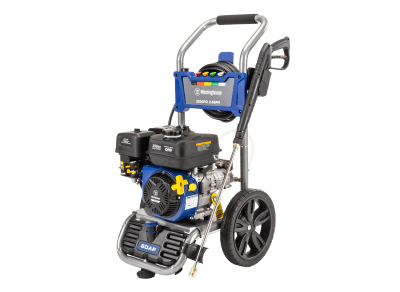
Westinghouse WPX3200

Westinghouse WPX3400

Simpson ALH3425-S

Simpson PowerShot PS4240
Introduction
Gas pressure washers occupy a category that electric models still cannot touch. When you need to blast embedded oil stains off a concrete driveway, strip peeling paint from a barn wall, or prep an entire deck for refinishing in a single afternoon, no battery or corded electric unit can match the sustained pressure, water volume, and runtime of a gas-powered machine.
But the category itself is full of confusing choices. PSI numbers get thrown around like a spec war, while the far more important GPM (gallons per minute) rating — which actually determines how fast you clean — gets buried in fine print. Engine quality varies wildly between brands, and the pump type can mean the difference between a machine that lasts a decade and one that dies in three seasons.
We evaluated the current gas pressure washer market with a focus on engine reliability, pump type, cleaning power (PSI × GPM), and real-world user feedback from Reddit communities, professional forums, and long-term owner reviews. Our five picks span every power tier — from a lightweight residential unit for weekend patio cleaning to a commercial-grade contractor machine built for daily job-site abuse.
Buying Advice: What Actually Matters in a Gas Pressure Washer
Before investing in a gas pressure washer, understand these four critical parameters that separate a reliable machine from an expensive headache.
PSI vs. GPM — and Why GPM Matters More Than You Think
PSI (Pounds per Square Inch) measures how hard the water hits the surface — it determines whether you can cut through grime. GPM (Gallons Per Minute) measures the volume of water flow — it determines how fast the loosened dirt rinses away. A machine with 4,200 PSI but only 2.0 GPM will scrub well but rinse slowly. A machine with 3,000 PSI and 4.0 GPM will clean large surfaces dramatically faster. The most useful single number is Cleaning Units (CU), which is simply PSI × GPM. Higher CU = faster cleaning across larger areas.
Engine: Honda GX vs. Everything Else
Honda's GX series engines are the gold standard in the outdoor power equipment industry. They start reliably in cold weather, require minimal maintenance, and have an enormous aftermarket parts network. Westinghouse OHV engines are a solid budget alternative — quiet, efficient, and reasonably durable — but their service ecosystem is far smaller. If you plan to use your pressure washer heavily for more than 3–4 years, a Honda engine pays for itself in reliability and parts availability.
Pump Type: Triplex Plunger vs. Axial Cam
This is the most overlooked spec in the category. Triplex plunger pumps are used on professional and commercial washers. They run cooler, last significantly longer, and are fully rebuildable — meaning you can replace internal seals and valves without buying a new pump. Axial cam pumps are cheaper, lighter, and maintenance-free (no pump oil changes), but they are disposable. When an axial cam pump fails, the entire pump assembly must be replaced. For homeowners who wash 10–20 times per year, axial cam pumps will last several seasons without issue. For heavy users, triplex is the only serious option.
Maintenance Expectations
Gas pressure washers require more hands-on care than electric models. You will need to perform regular engine oil changes, use fuel stabilizer if the machine sits idle for more than 30 days, and properly winterize the pump before cold storage. Failure to winterize — flushing antifreeze through the pump system — is the single most common cause of premature pump death. Budget 15 minutes of maintenance per use session.
Nozzle Safety: Match the Tip to the Surface
Every gas washer includes a set of 5 quick-connect nozzle tips rated by spray angle. The 0° (red) tip concentrates a pencil-thin jet for cutting through stubborn grime — never use it on wood or siding. The 15° (yellow) is ideal for concrete and brick. The 25° (green) handles general cleaning. The 40° (white) is the gentlest — safe for cars, windows, and delicate surfaces. The soap nozzle (black) drops pressure to draw detergent. Always start with a wider nozzle and work your way narrower.
Simpson PowerShot PS3228-S - Best Overall

Simpson PowerShot PS3228-S
Pros
- Honda GX200 engine — the industry benchmark for cold-start reliability and long-term durability
- AAA industrial triplex plunger pump is fully rebuildable and rated for commercial use
- Non-marring MorFlex hose resists kinks and won't scratch surfaces
- 10-year frame warranty, 5-year pump warranty — best-in-class coverage
- Five quick-connect nozzle tips included for instant pressure adjustment
Cons
- Weighs 77 lbs — noticeably heavier than axial-cam competitors
- Not CARB compliant — cannot be sold or shipped to California (49-State only)
- No onboard detergent tank — requires a siphon hose for soap application
Specifications
The Simpson PowerShot PS3228-S is the machine that professional pressure washing forums consistently recommend to homeowners who want to buy once and buy right. The formula is simple: pair the most reliable consumer engine in the world — the Honda GX200 — with a genuine commercial-grade AAA industrial triplex plunger pump, bolt them to a welded steel frame, and back it all with a 10-year frame warranty.
The result is a 3,300 PSI / 2.5 GPM machine that delivers 8,250 cleaning units of power — more than enough for any residential task and the majority of light commercial work. The triplex pump is the key differentiator. Unlike the axial cam pumps found on competing machines at this price point, the AAA triplex pump runs cooler under sustained load, handles thermal stress better, and is fully rebuildable. When seals eventually wear after years of use, you replace a $30 seal kit instead of buying a $200 pump assembly.
The 25-foot MorFlex hose is another thoughtful detail. It is engineered to resist kinking under pressure, and its outer sheath is non-marring — meaning it will not scratch painted surfaces, garage floors, or deck finishes when dragged across them. The 10-inch pneumatic tires roll smoothly over gravel, grass, and uneven terrain without getting stuck.
The downsides are manageable. At 77 lbs, it is the heaviest residential-class washer in our lineup, so lifting it into a truck bed is a two-person job. It also lacks a built-in soap tank, requiring you to use the included siphon hose to draw detergent from an external bucket. And if you are in California, this model is not CARB compliant.

Close-up view of the Simpson PowerShot PS3228-S pressure washer showing its Honda GX200 engine, top panel with nozzle tips, and coiled hose
Westinghouse WPX3200 - Best Light-Duty

Westinghouse WPX3200
Pros
- Lightest gas washer in our lineup at just 63 lbs — easy to move and store
- Built-in 1.6-liter onboard soap tank eliminates siphon hose hassle
- Maintenance-free axial cam pump — no pump oil changes required
- Outstanding value at under $350 for genuine gas-powered cleaning
- Five quick-connect nozzles allow instant pressure control from 0° to soap mode
Cons
- Westinghouse proprietary engine — less aftermarket support than Honda
- Axial cam pump is not rebuildable — entire pump must be replaced if it fails
- 25-ft hose can feel limiting on larger properties
Specifications
The Westinghouse WPX3200 exists because true "light-duty" gas pressure washers — machines rated at 2,000 to 2,400 PSI — have essentially disappeared from the market. Manufacturers discovered that residential gas engines can easily drive higher-pressure pumps, and buyers gravitated toward higher spec sheets. The result is that the lightest, most affordable gas washer you can buy today still delivers 3,200 PSI.
That is not a problem — it is an advantage. The WPX3200 gives you genuine gas-level power while remaining the most approachable machine in this roundup. At 63 lbs, it is 14 lbs lighter than the Simpson PowerShot and easy enough for one person to move in and out of a garage or truck. The built-in 1.6-liter soap tank is a welcome convenience that the Simpson lacks — fill it with your preferred detergent, switch to the black soap nozzle, and spray without fumbling with siphon hoses.
The Westinghouse 212cc OHV engine is reliable and quiet, though it does not have Honda's legendary aftermarket parts network. The axial cam pump is maintenance-free — no pump oil changes needed — but it is a wear part that will eventually need full replacement rather than a simple seal rebuild. For homeowners who wash their car, patio furniture, and siding 10–15 times per year, this pump will last comfortably for several years.
At under $350, the WPX3200 is the value champion. It is the right machine for first-time gas washer buyers, small property owners, and anyone who prioritizes portability and simplicity over long-term serviceability.

Before and after comparison of garden border bricks showing one moss-covered block next to a clean block.
Westinghouse WPX3400 - Best Medium-Duty

Westinghouse WPX3400
Pros
- 3,400 PSI and 2.6 GPM deliver 8,840 cleaning units — the driveway and deck sweet spot
- Same lightweight 63-lb frame as the WPX3200 despite higher output
- Built-in 1.6L soap tank for convenient detergent application
- Reddit's most-recommended value pick for gas pressure washers
- Pro-style steel wand and heavy-duty spray gun feel professional-grade
Cons
- Westinghouse engine lacks Honda's aftermarket parts ecosystem
- Axial cam pump is not serviceable — replacement required if pump fails
- 25-ft hose may require repositioning the unit on larger driveways
Specifications
The Westinghouse WPX3400 is the machine Reddit's pressure washing community recommends more than any other model in its price range — and the reasons are immediately obvious. For just $50 more than the WPX3200, you get a meaningful jump to 3,400 PSI and 2.6 GPM, pushing the total cleaning power to 8,840 CU. That extra output makes a tangible difference when you are working on stained concrete driveways, weathered deck boards, or fence panels coated in mildew.
The physical platform is identical to the WPX3200 — same 63-lb frame, same 212cc Westinghouse OHV engine, same axial cam pump design. The WPX3400 simply extracts more performance from the same architecture through internal pump tuning. The built-in 1.6-liter soap tank remains, and the pro-style steel wand and heavy-duty spray gun have a noticeably solid feel that belies the machine's budget price point.
Where the WPX3400 earns its "medium-duty" badge is in the kinds of jobs it handles without breaking a sweat. Oil spots on a concrete garage floor. A full two-car driveway in under an hour. A wood fence that has not been cleaned in three years. The 15° nozzle at 3,400 PSI cuts through embedded grime that would require multiple slow passes at 3,200 PSI.
The trade-offs are the same as its smaller sibling. The Westinghouse engine is solid but lacks Honda's parts ecosystem. The axial cam pump is maintenance-free but disposable. The 25-ft hose can mean repositioning the machine mid-job on large driveways. But at $379, the WPX3400 is the best dollar-per-cleaning-unit machine on this list and the single best gas pressure washer for typical suburban homeowners.

Westinghouse WPX3400 pressure washer on a wooden deck that is half-cleaned and half-dirty.
Simpson ALH3425-S - Best Heavy-Duty

Simpson ALH3425-S
Pros
- Honda GX200 engine — the same legendary powerplant as the PS3228-S, with proven cold-start reliability
- AAA industrial triplex plunger pump is fully rebuildable — the same commercial-grade pump technology as the PS3228-S
- Aircraft-grade aluminum frame is corrosion-resistant and significantly lighter than welded steel
- 35-ft MorFlex hose provides 10 extra feet of reach over the PS3228-S for larger job sites
- 3,600 PSI delivers 300 more PSI than the PS3228-S for heavy stripping and prep work
Cons
- Weighs 78 lbs — slightly heavier than the PS3228-S despite the aluminum frame
- Not CARB compliant — cannot be sold or shipped to California (49-State only)
- No onboard detergent tank — requires a siphon hose for soap application
Specifications
The Simpson ALH3425-S is the natural step up from the PS3228-S for users who need more raw pressure without jumping to a 130+ lb commercial rig. It uses the exact same winning combination — a Honda GX200 engine paired with an AAA industrial triplex plunger pump — but pushes the output to 3,600 PSI and 2.5 GPM, delivering 9,000 cleaning units. That extra 300 PSI over the PS3228-S makes a real difference when you are stripping old paint, cutting through heavy grease on farm equipment, or blasting embedded grime off neglected concrete.
The frame is where the ALH3425-S diverges from its siblings. Instead of welded steel, Simpson uses aircraft-grade aluminum — a material that is inherently corrosion-resistant and will not rust even after years of outdoor storage or wet-weather use. This matters if your pressure washer lives in a barn, an open shed, or a truck bed that gets rained on. The 10-inch premium pneumatic tires roll smoothly over gravel, grass, and rough terrain.
The 35-foot MorFlex hose is another significant upgrade over the PS3228-S's 25-foot hose. Those extra 10 feet eliminate the need to reposition the machine as frequently on larger driveways, decks, and fence lines. Like all MorFlex hoses, it is engineered to resist kinking under pressure and its outer sheath is non-marring to protect painted surfaces.
Because the ALH3425-S shares the same Honda GX200 engine and AAA triplex pump as the PS3228-S, you get the same legendary parts availability, the same rebuildable pump architecture, and the same long warranty coverage. The main trade-offs are weight (78 lbs vs. 77 lbs — essentially identical) and price (approximately $200 more than the PS3228-S). If your cleaning demands regularly exceed what 3,300 PSI can handle, the ALH3425-S is the most logical upgrade path without moving to a commercial-class machine.
Simpson PowerShot PS4240 - Best Commercial-Grade

Simpson PowerShot PS4240
Pros
- Honda GX390 engine — the same 389cc motor used in commercial concrete saws and generators
- 4.0 GPM water flow is the real star — rinses dirt off massive surfaces 60% faster than 2.5-GPM residential units
- AAA industrial triplex plunger pump is fully rebuildable for decade-long service life
- 50-ft Monster Hose eliminates constant machine repositioning on large job sites
- CETA-certified performance — independently verified pressure and flow ratings
Cons
- Extremely heavy at 136 lbs — requires two people or a trailer to transport
- Not CARB compliant — unavailable in California (49-State only)
- Price exceeds $1,000 — overkill for residential-only use
Specifications
The Simpson PowerShot PS4240 is the machine that professional pressure washing businesses actually use on job sites. Everything about it is engineered for daily commercial abuse — from the Honda GX390 engine (a 389cc behemoth that Honda also builds into concrete cutters, water pumps, and industrial generators) to the AAA industrial triplex plunger pump with brass manifold heads.
The headline spec is 4,200 PSI / 4.0 GPM, producing an enormous 16,800 cleaning units. But the real story is the 4.0 GPM flow rate. While residential washers push water at 2.5 GPM, the PS4240 delivers 60% more water per minute — that difference in rinsing volume translates to dramatically faster turnaround on large commercial parking lots, fleet vehicles, or expansive building facades.
The 50-foot Monster Hose is a contractor-specific feature that eliminates constant machine repositioning. It is 3/8-inch diameter, dual-braided for extreme durability, and kink-resistant under the high flow rates the GX390 engine generates. The welded steel frame, powder-coated for corrosion resistance, sits on 13-inch premium pneumatic tires that roll over construction debris, gravel, and rough terrain.
At 136 lbs, this machine is not casually portable. You will need a truck or trailer, and loading it is a two-person job. The price exceeds $1,000, and it is not CARB compliant for California. But if you are running a pressure washing business or maintaining commercial properties, the PS4240's combination of Honda GX390 reliability, a rebuildable triplex pump, CETA-certified performance ratings, and decade-long warranty coverage makes it the only serious choice at this tier.

Simpson commercial-grade pressure washer showing its heavy-duty steel frame, console, and premium pneumatic tires.
Conclusion
Choosing the right gas pressure washer comes down to matching the machine's power tier to your actual cleaning demands — and being honest about how much maintenance you are willing to perform.
- For maximum long-term reliability at a residential price, the Simpson PowerShot PS3228-S is the undisputed best overall. Its Honda GX200 engine and rebuildable triplex pump will outlast every other machine on this list except the PS4240.
- For first-time buyers and light residential use, the Westinghouse WPX3200 delivers real gas power at under $350 with the easiest setup and lightest frame in the category.
- For driveways, decks, and general home maintenance, the Westinghouse WPX3400 hits the sweet spot — delivering noticeably more cleaning power than the WPX3200 for just $50 more.
- For heavy-duty property maintenance and farm use, the Simpson ALH3425-S pairs a Honda GX200 engine and AAA triplex pump with 3,600 PSI of stripping power in a corrosion-resistant aluminum frame.
- For commercial contractors and daily professional use, the Simpson PowerShot PS4240 is the only machine here built to survive years of daily job-site abuse.
Regardless of which machine you choose, invest in a surface cleaner attachment for driveways (a flat disc that prevents streaking), use fuel stabilizer if the machine will sit for more than a month, and always winterize the pump before cold storage. A well-maintained gas pressure washer will deliver reliable service for a decade or more.
Product Comparison at a Glance
| Product | Brand | PSI | GPM | Engine | Hose Length | Weight | Price | Action |
|---|---|---|---|---|---|---|---|---|
#1Simpson PowerShot PS3228-S | Simpson | 3,300 | 2.5 | Honda GX200 | 25 ft | 77 lbs | $529 | |
#2Westinghouse WPX3200 | Westinghouse | 3,200 | 2.5 | Westinghouse 212cc OHV | 25 ft | 63 lbs | $329 | |
#3Westinghouse WPX3400 | Westinghouse | 3,400 | 2.6 | Westinghouse 212cc OHV | 25 ft | 63 lbs | $379 | |
#4Simpson ALH3425-S | Simpson | 3,600 | 2.5 | Honda GX200 | 35 ft | 78 lbs | $729 | |
#5Simpson PowerShot PS4240 | Simpson | 4,200 | 4.0 | Honda GX390 | 50 ft | 136 lbs | $1,149 |