
Our Picks
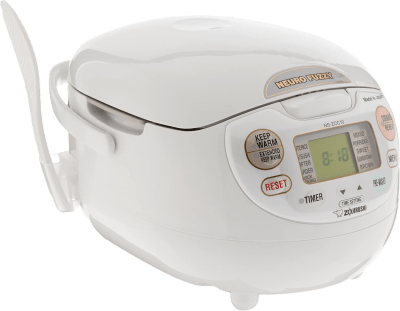
Zojirushi Neuro Fuzzy Rice Cooker

Tiger JBV-S10U with Tacook
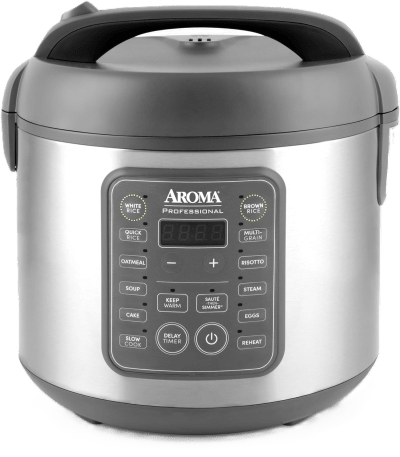
Aroma Housewares ARC-5200SB
Introduction
Here's a confession: I used to think rice cookers were pointless. I'd been making rice on the stove my whole life — boil water, dump rice, lower the flame, set a timer. Worked fine. Why would I spend $200 on an appliance that does one thing I can already do with a $15 saucepan?
Then I actually lived with one. And the thing nobody tells you isn't that a rice cooker makes better rice (though often it does). It's that it makes rice invisible. You stop thinking about it entirely. No watching the pot, no adjusting the burner, no scraping burnt grains off the bottom because you got distracted by a phone call. You press a button and walk away. Thirty minutes later, perfect rice, every single time. It's the kitchen equivalent of an automatic transmission — you don't realize how much mental energy you were burning until you stop.
But that raises the real question: is it worth the counter space? What can you actually cook in one beyond rice? And do the expensive Japanese machines truly justify the price tag, or is a $65 model just as good? Here are three rice cookers at very different price points that answer those questions honestly.
Rice Cooker vs. Saucepan: The Honest Comparison
Let's kill the suspense: in a side-by-side blind taste test, most people cannot tell the difference between rice cooked in a good rice cooker and rice cooked well on the stove. The grains taste the same. If you're skilled with a saucepan and you enjoy the process, a rice cooker will not magically transform your rice into something otherworldly.
So why buy one? Three words: consistency without attention.
Stovetop rice demands your presence. You watch for the boil, drop it to a simmer, time it, don't lift the lid, rest it after cooking. It takes roughly 20 minutes of active-ish engagement for white rice, more for brown. Mess up one variable — too much water, flame slightly too high, forgot about it for five minutes — and you're eating mushy porridge or scraping a burnt crust off your pan.
A rice cooker eliminates all of that. It monitors temperature and moisture content with built-in sensors. When the water is absorbed and the temperature at the bottom of the pot starts rising past 100°C, the machine knows the rice is done and switches to "keep warm." You can press the button, leave the house, come back two hours later, and your rice is still sitting at a perfect serving temperature. Try that with a saucepan.
The real-world scenario where a rice cooker earns its keep is the weeknight dinner. You're juggling a stir-fry on the stove, helping a kid with homework, and trying to remember if you turned off the bathroom light. The last thing you need is one more thing demanding your attention. The rice cooker handles itself. That's the value proposition — not taste, but mental bandwidth.
When the saucepan wins
If you want tahdig (that crispy Persian rice crust), a saucepan gives you the manual heat control to nail it. If you're making nurungji (Korean scorched rice), same deal. If you cook rice once a week or less, or you have zero counter space, a saucepan is perfectly fine. Nobody needs a rice cooker. But if rice is a staple in your house three or more times a week, the convenience compounds fast.
What You Can Actually Cook in a Rice Cooker (And What You Can't)
The surprisingly long list of things it handles
A rice cooker is essentially a sealed pot with a thermostat. That means anything that cooks by boiling, steaming, or gentle simmering is fair game:
Grains beyond rice: Quinoa, farro, barley, and polenta all cook perfectly with adjusted water ratios. Oatmeal is a revelation — set the delay timer before bed, and you wake up to hot steel-cut oats without touching the stove.
Steamed proteins: Most mid-range rice cookers come with a steaming basket. Lay fish fillets, dumplings, or chicken thighs on the basket while rice cooks underneath. Dinner and side dish, one appliance, one button. The Tiger JBV-S10U was literally designed for this with its Tacook synchronized plate.
One-pot meals: Throw rice, broth, diced vegetables, and a protein into the pot. Press cook. You've got a hands-free burrito bowl base, chicken rice soup, or fried-rice-adjacent grain bowl with zero effort. College students have been doing this for decades.
Hard-boiled eggs: Drop eggs in the steaming basket. They come out perfectly cooked every time. No boiling water, no ice bath drama.
Soups and stews: The Aroma ARC-5200SB has a dedicated slow-cook mode for exactly this. Dump ingredients, set it, eat four hours later.
Cake: Yes, really. Japanese home cooks routinely bake sponge cakes in rice cookers. Pour in batter, press cook, done. It won't replace your oven, but if you live in a dorm room, it's a legitimate hack.
What it can't do
Anything that needs dry, high heat: No searing, no browning, no stir-frying (with the exception of models like the Aroma that have a sauté function, and even then it's limited). If a recipe calls for a hot skillet or a blast of oven heat, the rice cooker can't help.
Risotto: Traditional risotto requires constant stirring and gradual liquid addition to coax out the starch. A rice cooker can make a risotto-adjacent dish, but it won't replicate the real thing.
Delicate quick-cooking vegetables: Asparagus, spinach, and snow peas cook in 2-3 minutes. A rice cooker's cycle is too long. Add them at the very end or use the steaming basket for the last few minutes only.
Anything acidic for extended periods: Tomato-heavy sauces and vinegar-based recipes can corrode the nonstick coating over time. An occasional use is fine, but don't make it a habit.
How Long Do Rice Cookers Actually Last?
This is where the price conversation gets interesting. A $30 basic rice cooker from a no-name brand will typically last 2-4 years before the heating element gives out, the nonstick coating starts flaking, or the thermal sensor drifts and starts undercooking everything. At that point, you throw it out and buy another one.
A mid-range machine — the Tiger JBV-S10U or the Aroma ARC-5200SB — runs 5-8 years with normal use. The most common failure point is the inner pot's nonstick coating wearing thin from daily use and occasional scrubbing. Both Tiger and Aroma sell replacement inner pots, so you don't have to replace the whole machine.
And then there's the Zojirushi tier. On Reddit's r/BuyItForLife and r/RiceCookers, people routinely post photos of their 15-year-old, 20-year-old, even 28-year-old Zojirushi machines still going strong. The build quality is legitimately different — thicker inner pots, more robust heating elements, and importantly, Zojirushi still sells replacement parts (gaskets, inner pots, power cords) for models that are over a decade old. It's the rice cooker equivalent of buying a Toyota Camry: boring, reliable, and still running when everything else has been replaced twice.
The math works out simply. Three $30 rice cookers over 10 years = $90 plus the hassle of replacing them. One $215 Zojirushi over the same period = $215 and zero hassle. Over 15+ years, the Zojirushi is actually cheaper. That's the case for spending more upfront.
Zojirushi Neuro Fuzzy NS-ZCC10 - The 20-Year Machine
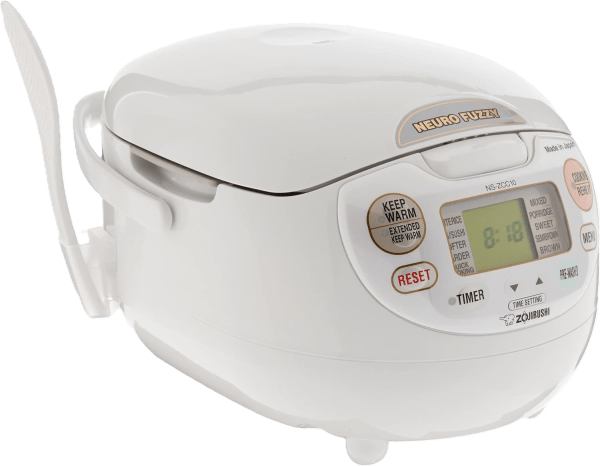
Zojirushi Neuro Fuzzy Rice Cooker
Pros
- Neuro Fuzzy logic automatically adjusts temperature and cooking time mid-cycle for consistently perfect texture
- Made in Japan with build quality that routinely lasts 15-20+ years with basic maintenance
- Multiple grain-specific presets: white (regular/softer/harder + sushi), brown, porridge, mixed, sweet, semi-brown, rinse-free, and quick cook
- Retractable power cord and compact design for the capacity it delivers
Cons
- No induction heating — uses conventional heating elements, which is fine for most but not the absolute pinnacle of rice texture
- At ~$215, it costs 3x more than basic models and the difference is hard to appreciate until you've lived with it
- LCD display and button interface feel dated compared to modern touchscreen appliances
Specifications
What Fuzzy Logic actually means in practice
"Fuzzy logic" sounds like marketing fluff, but it's a real engineering approach. The NS-ZCC10 uses sensors to continuously monitor temperature and adjust heating throughout the cooking cycle. In practical terms, this means if you accidentally added a little too much water, or you switched from a short-grain to a medium-grain rice without changing the settings, the machine compensates automatically. The result is consistent rice quality that doesn't require you to be precise about measurements. It forgives your mistakes, which is something a saucepan absolutely will not do.
Why people keep them for two decades
This is the part that's hard to convey in a review but easy to verify in any cooking forum: people do not replace their Zojirushi rice cookers. They just don't. The inner pot holds up, the heating element stays calibrated, the lid seal remains tight. Zojirushi manufactures this model in Japan and maintains replacement part availability for over a decade after purchase. When the inner pot's nonstick coating eventually wears (usually around year 8-10 with daily use), you buy a $40 replacement pot and keep going. Compare that to a cheap rice cooker where the entire unit goes in the trash when the coating fails.
The 24-hour keep warm that actually works
A lot of rice cookers claim "keep warm" functionality that really means "keep rice in a barely heated pot until it dries out and forms a crust." The Zojirushi's extended keep warm genuinely maintains rice at serving temperature for up to 24 hours without significant texture degradation. For households where family members eat at different times — someone eats at 6 PM, another at 9 PM — this is genuinely useful.
Tiger JBV-S10U - The Weeknight Shortcut

Tiger JBV-S10U with Tacook
Pros
- Tacook synchronized cooking plate lets you steam a protein or vegetables while rice cooks below — dinner in one appliance
- 10 cooking menu settings including Plain/Synchro-Cooking, Brown, Multigrain, Slow Cook, Porridge, and Steam
- Scratch-resistant fluorine-coated inner pot that's genuinely easy to clean
- Compact and lightweight at 5.7 lbs — easy to store when counter space is tight
Cons
- Keep warm maxes out at 12 hours vs. Zojirushi's 24-hour capability
- No Wi-Fi or app control — strictly button-operated
- Tacook plate works best with thin fillets and small portions; don't expect to steam a full chicken breast evenly
Specifications
Tacook: The feature that solves Tuesday night dinner
The Tiger JBV-S10U's signature feature is the Tacook cooking plate — a BPA-free tray that sits on top of the rice while it cooks. You place a protein or vegetables on the tray, rice and water below, press one button, and both cook simultaneously using the same steam cycle. The steam from the rice cooks the food above, while a separator prevents drips from flavoring the rice below.
In real life, this means you can have salmon and rice, steamed vegetables and quinoa, or chicken and brown rice ready in one cycle, with one appliance, and one thing to clean. It's not a gimmick — it genuinely works for thin fillets, sliced vegetables, and dumplings. Just don't try to cook a thick bone-in chicken thigh on the Tacook plate; it needs more direct heat than steam can provide.
The practical middle ground
At around $90-120, the Tiger sits between the Aroma's budget versatility and the Zojirushi's premium longevity. Its Micom (microcomputer) technology is a step up from basic on/off models — it monitors cooking and adjusts temperature, though not as granularly as Zojirushi's fuzzy logic. The 10 menu settings cover every common grain type plus slow cooking and steaming. The inner pot's fluorine coating is scratch-resistant and genuinely easy to clean. At 5.7 lbs, it's also the lightest machine on this list, which matters if you're pulling it out of a cabinet each time rather than leaving it on the counter. Like the Zojirushi, the JBV-S10U is made in Japan.
Where it falls short
Keep warm tops out at 12 hours, which is fine for most meals but limiting if you're cooking rice in the morning for dinner. The build quality is solid but not "pass it down to your kids" solid. Expect 5-7 years of reliable daily use before the coating starts showing age.
Aroma ARC-5200SB - The Budget All-Rounder

Aroma Housewares ARC-5200SB
Pros
- 15 automated cooking programs including Sauté-then-Simmer, risotto, oatmeal, and soup — far beyond just rice
- 20-cup cooked capacity makes it viable for meal prepping or feeding a large household
- Functions as a rice cooker, 5-quart slow cooker, and food steamer in one appliance
- 15-hour delay timer lets you prep at night and wake up to finished oatmeal or congee
Cons
- 20-cup capacity means it's physically large — awkward for apartments or small kitchens
- Rice texture doesn't match the Zojirushi or Tiger; adequate but not exceptional for plain white rice
- Nonstick coating on the inner pot is thinner than premium brands and may show wear after 2-3 years of heavy use
Specifications
The "do I even need a rice cooker?" starter machine
If you've never owned a rice cooker and you're not sure you want to commit $200 to find out, the Aroma ARC-5200SB is the answer. At roughly $65, it removes the financial anxiety from the decision. And unlike cheap no-name rice cookers at the same price, the Aroma is genuinely versatile — it's a rice cooker, a 5-quart slow cooker, and a food steamer in one unit. Its 15 automated programs include settings for oatmeal, risotto, soup, and even a Sauté-then-Simmer mode that lets you brown aromatics before adding liquid. For $65, that's a lot of functionality.
The rice: good enough, not great
Let's be honest about what $65 buys you. The Aroma makes perfectly acceptable rice. It's properly cooked, not mushy, not burnt. But side-by-side against the Zojirushi, the texture difference is noticeable — the Zojirushi produces slightly fluffier, more distinct grains with a better chew. The Aroma's rice is a B+; the Zojirushi's is an A. For most people eating rice with a curry or stir-fry, the Aroma's output is more than fine. If you eat plain steamed rice as a centerpiece of your meal (as in Japanese or Korean cuisine), the texture gap matters more.
Size: A blessing and a curse
The 20-cup cooked capacity makes the ARC-5200SB excellent for families, meal preppers, and anyone hosting dinner parties. It also makes it physically large. If your kitchen counter is already contested real estate, this machine will lose the turf war. Measure before you buy. For a smaller household, Aroma makes compact 8-cup models that take up significantly less space but sacrifice the slow cooker and multicooker features.
Durability reality check
The nonstick coating on the Aroma's inner pot is thinner than what you get from Zojirushi or Tiger. With daily use and occasional scrubbing, expect it to show wear marks around year 2-3. Aroma sells replacement pots, but at that point you might start wondering if you should have just bought the Tiger. The honest answer: the Aroma is an excellent $65 machine for 3-5 years. It's not a 10-year investment, and it doesn't pretend to be.
The Bottom Line
If you eat rice three or more times a week and you want the last rice cooker you'll ever buy, get the Zojirushi NS-ZCC10. It's $215, it's boring, and you'll still be using it when your lease expires. The fuzzy logic genuinely delivers consistent results that require zero babysitting, and the keep-warm function means rice is ready whenever you are.
If you're a busy parent or couple who wants to cook a complete dinner in one appliance with one button press, the Tiger JBV-S10U and its Tacook plate solve a real, everyday problem. It's the rice cooker for people who don't love cooking but still want to eat well on a Tuesday night.
And if you're not sure a rice cooker is even for you, the Aroma ARC-5200SB at $65 removes the risk entirely. It does far more than just rice, and if you end up loving it, you'll know exactly what to look for when you upgrade in a few years.
One last thing: a rice cooker isn't a speed upgrade over a saucepan. It's an attention upgrade. The rice won't cook faster. But your evening will feel faster, because you stopped thinking about the rice entirely. That's what you're actually buying.
Product Comparison at a Glance
| Product | Brand | Technology | Capacity | Menu Settings | Keep Warm | Best For | Action |
|---|---|---|---|---|---|---|---|
#1Zojirushi Neuro Fuzzy NS-ZCC10 | Zojirushi | Neuro Fuzzy Logic | 5.5 cups (10 cooked) | 8 presets (incl. Rinse-Free) | Up to 24 hours | Daily Rice Eaters | |
#2Tiger JBV-S10U with Tacook | Tiger | Micom + Tacook | 5.5 cups (11 cooked) | 10 presets | Up to 12 hours | Busy Families | |
#3Aroma Housewares ARC-5200SB | Aroma | Digital Multicooker | 10 cups (20 cooked) | 15 programs | Auto Keep Warm | First-Time Buyers |